
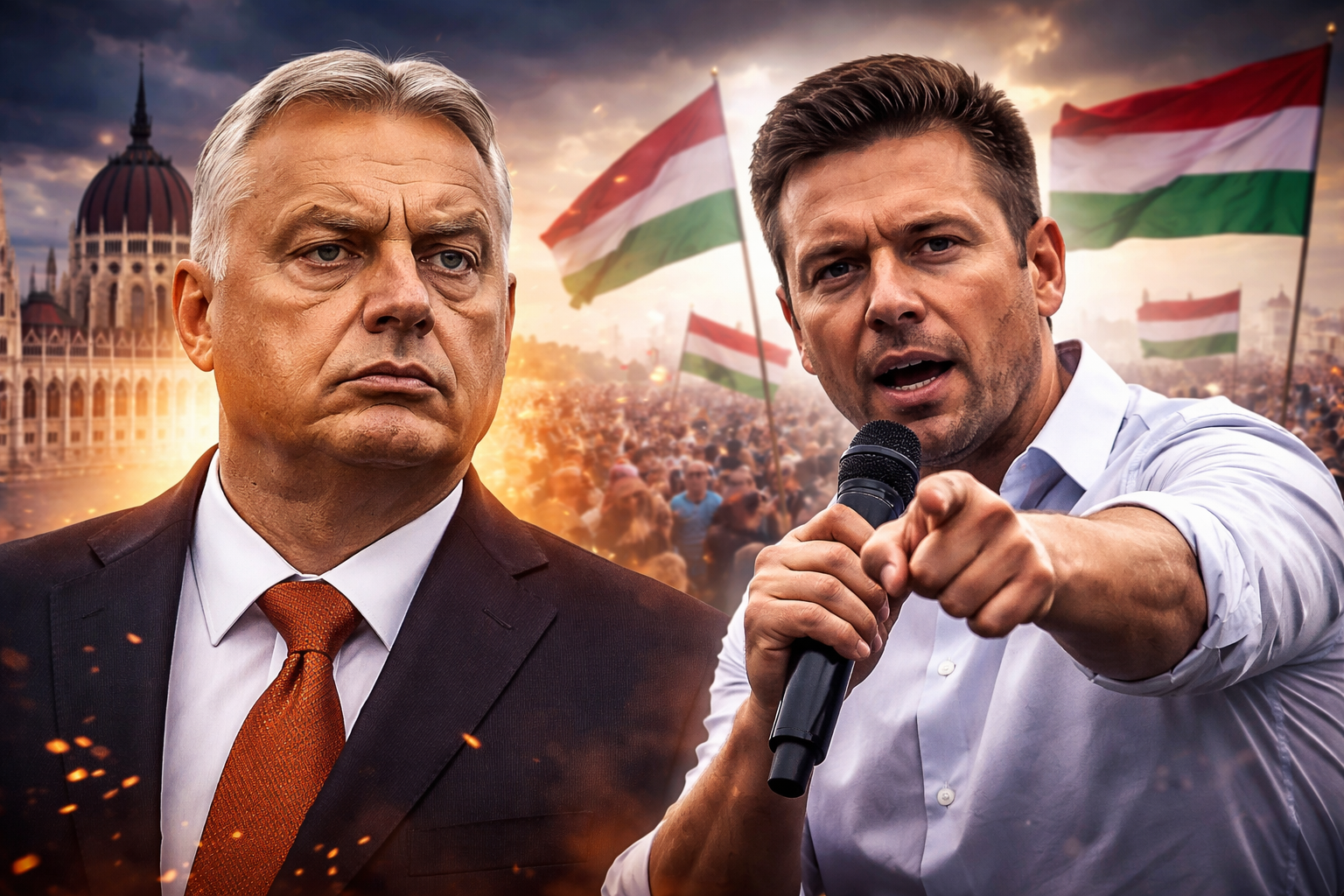
On Sunday, April 12, Hungarians go to the polls in what may be the most economically consequential election in the EU this year — one whose result will be felt from Brussels to Kyiv, and increasingly, from Washington too.
Hungary’s economy tells its own story.
GDP per capita sits at 76% of the EU average.
The country now trails Romania, Poland, and Bulgaria in household consumption.
Bread costs three times what it did a few years ago; wages have barely moved.
Seventeen billion of Hungary’s 27 billion euros in allocated EU funds remain frozen over rule-of-law concerns, and the country became a net contributor to the EU budget for the first time since its 2004 accession — paying in more than it gets back.
That is the economic record after 16 years of Viktor Orbán.
And it is the backdrop against which a surprise challenger, Péter Magyar, has surged ahead in polls, promising to unlock frozen EU money, restore institutional credibility, and return Hungary to the mainstream of European economic governance.
But the election has acquired a dimension that goes well beyond domestic reform.
With US Vice President JD Vance flying into Budapest days before the vote to endorse Orbán from a campaign stage — and accusing the EU of election interference in the same breath — the contest has become a proxy war between two competing visions for the Western alliance itself: one anchored in EU institutions and rules-based economic integration, the other gravitating toward a Washington-backed nationalist model that treats Brussels as the adversary.
The forint is near its strongest level against the euro in three years. Markets, at least, have already placed their bet.
How Orbán built a system designed to last forever
Orbán first came to power in 1998 as a pro-European reformer. He lost in 2002, spent eight years rebuilding his party, and returned in 2010 riding a wave of post-financial crisis fury.
That second comeback gave him something rare in democratic politics: a two-thirds parliamentary supermajority, enough to rewrite the constitution itself.
He used it without hesitation.
New electoral maps. New compensatory vote rules that amplify winners and punish fragmented opposition.
Loyalists installed in courts, regulators, universities, and media boards. A new oligarch class built around family and childhood friends.
By 2014, Fidesz was winning two-thirds of seats on vote shares well below two-thirds of votes. The system worked exactly as designed.
Hungary now ranks as the EU’s most corrupt member state for the thirteenth consecutive year according to Transparency International. GDP per capita sits at 76% of the EU average.
Hungary trails Romania, Poland, and Bulgaria in household consumption. Bread costs three times what it did a few years ago, and wages have not moved.
The man who broke the wall
Péter Magyar was not supposed to exist.
A lawyer, former diplomat, and state company executive, he was a Fidesz insider married into its inner circle. In early 2024, a presidential pardon in a child abuse case triggered a chain of resignations that implicated his ex-wife, then Justice Minister.
Magyar went on live television and accused the government of systemic hypocrisy and corruption. The clip went viral within hours.
Within weeks, he had staged a mass protest.
Within months, his brand-new Tisza Party won 30% in European Parliament elections, finishing second only to Fidesz. He has not stopped since.
What makes Magyar uniquely dangerous to Orbán is his origin. He cannot be painted as a foreign-funded liberal.
He is a conservative who knows exactly how the machine works, because he worked inside it. His campaign focuses on corruption, rule of law, and economic competence rather than ideology, giving him the broadest possible coalition.
Polls from independent firms put Tisza ahead by double digits. The prediction market Polymarket put the odds of a Magyar victory above 70% on Thursday.
The Hungarian forint is trading near its strongest level against the euro in three years.
What is actually at stake?
This election is not a domestic Hungarian affair. It sits at the intersection of the Russia-West confrontation, the Ukraine war, and a global contest between liberal democracy and its challengers.
Orbán has spent years wielding Hungary’s EU veto as a weapon. Because EU foreign policy requires unanimity, a single Budapest veto is enough to block critical decisions.
He has used it to obstruct Ukraine aid, delay sanctions on Russia, and most recently block a 90 billion euro EU loan to Kyiv.
He has refused to phase out Russian oil and gas imports. His Foreign Minister was caught on leaked recordings briefing his Russian counterpart on the contents of confidential EU foreign ministers’ meetings.
Bloomberg reviewed a transcript showing Orbán told Putin he was willing to assist him “in any way,” comparing himself to a mouse helping a lion.
Russia’s Foreign Intelligence Service reportedly drafted plans to stage a false flag assassination attempt on Orbán to boost his poll numbers, according to a document obtained and authenticated by a European intelligence service. Russian bot networks then spread that narrative online.
Meanwhile, 17 billion of Hungary’s 27 billion euros in allocated EU funds remain frozen over corruption and rule-of-law concerns.
Hungary permanently forfeited over a billion euros at the end of 2024 when the legal clock ran out.
The country has become a net contributor to the EU budget for the first time since its 2004 accession, paying in more than it receives.
Washington arrives at the campaign rally
Five days before the election, US Vice President JD Vance flew to Budapest and told a stadium crowd to “stand with Viktor Orbán.”
He called Orbán “one of the only true statesmen in Europe.”
He accused the EU of the worst foreign election interference he had ever seen, while standing on a campaign stage doing exactly that.
Secretary of State Marco Rubio had already visited in February.
Trump sent a video message to CPAC Hungary with “complete and total endorsement.” Eleven international figures, including Marine Le Pen, Giorgia Meloni, and Javier Milei, appeared in a video backing Orbán in January.
The strategic logic is plain.
Orbán is the proof of concept for nationalist populism as a governing model. His defeat would shatter that narrative internationally.
The vote that might not be enough
Even winning is complicated.
Because of how the electoral system is engineered, Tisza needs to win the popular vote by roughly five percentage points just to secure a bare majority of seats. A double-digit lead may translate into a workable majority.
The latest Median poll suggests Tisza could reach the two-thirds supermajority threshold, which would allow Magyar to amend the constitution and legally remove Orbán’s loyalists from appointed positions in the judiciary, prosecution service, and regulatory bodies.
Without that supermajority, reform becomes a grinding war against embedded institutional resistance, similar to Poland’s experience since ousting Law and Justice in 2023.
Up to 400,000 votes in impoverished rural communities remain genuinely in play. These are people embedded in Fidesz’s clientelist machine, where local mayors control access to government jobs paying 300 to 450 dollars a month.
Voting against the ruling party can mean losing your livelihood. A documentary released last month showed how food aid, small payments, and job pressure are used to mobilise support in these areas.
What comes after Sunday?
If Magyar wins with a supermajority, the EU is ready to fast-track the release of frozen funds, the 90 billion euro Ukraine loan moves forward, and Hungary’s systematic obstruction of Western policy ends.
Slovakia’s Robert Fico, Orbán’s closest remaining EU ally, is expected to fold without Budapest’s backing.
If Orbán survives, one EU official said the “gloves will come off,” with Article 7 proceedings to suspend Hungary’s voting rights among the options on the table.
There is a third scenario where Orbán controls the Constitutional Court, the State President, and the Fiscal Council. He has reportedly explored introducing a presidential system that could allow him to remain in power even after losing the prime ministership.
The election result and the transfer of power are not the same thing.
16 years, a rewritten constitution, a media landscape captured, courts packed, an electoral system engineered for permanence.
If Magyar’s Tisza Party manages to break through all of that through a democratic vote, it will send a message that travels far beyond Budapest.
It will mean that even the most elaborate system of democratic self-defence can still be undone by the people it was built to contain.
That is the story on April 12.
The post Magyar vs Orbán: The €17B EU funding freeze at the heart of Hungary's election appeared first on Invezz
